Summary
For hospital administrators, patient experience leaders, and operations managers, the stakes have never been higher. Since 2012, HCAHPS patient satisfaction scores have been pivotal in hospital reimbursement through the Hospital Value-Based Purchasing Program, with hospitals earning higher reimbursements based on higher HCAHPS scores. In fact, around 30% of hospital metrics used for Value-Based Purchasing calculations are based on HCAHPS scores, making them a significant factor in determining hospital reimbursements.
Yet most hospitals remain shackled to an outdated feedback model: post-discharge surveys that arrive days or weeks after a patient’s experience ends. Post-discharge surveys rely on patient memory, often clouded by stress, recovery, and time. By the time negative feedback reaches your team, the opportunity to fix the issue has long passed.
This white paper demonstrates why leading hospitals are abandoning traditional HCAHPS only approaches and implementing real-time feedback kiosk solutions to capture patient sentiment at the moment of care which helps enabling immediate service recovery and measurable improvements in HCAHPS scores that directly impact hospital revenue.
I. The Financial Stakes: Why HCAHPS Scores Matter Now More Than Ever
1.1 Direct Revenue Impact
Patient satisfaction scores account for an estimated 25% of Medicare reimbursement through the Value-Based Purchasing program. This represents significant revenue at stake for any hospital system. Consider this:
- A 300-bed hospital with annual Medicare revenue of $150 million sees approximately $37.5 million tied directly to HCAHPS performance
- According to a 2025 AHA analysis, hospitals that improved environmental HCAHPS scores by just 5 points saw a 0.8% boost in net margins due to higher CMS incentive payments and improved patient retention.
- For a hospital with $200 million in annual revenue, a 0.8% margin improvement equals $1.6 million in additional revenue annually
1.2 What HCAHPS Measures
The HCAHPS survey contains 22 core questions about critical aspects of patients’ hospital experiences, including communication with nurses and doctors, responsiveness of hospital staff, cleanliness and quietness of the hospital environment, communication about medicines, discharge information, and overall rating of hospital.
These aren’t esoteric metrics, they directly reflect operational performance across your entire hospital system.
II. The Problem: Why Traditional Post-Discharge Surveys Fail
2.1 The Timing Problem: Too Late for Service Recovery
Depending on the mode of administration, HCAHPS survey responses can be received 48 hours to 3 months after hospital discharge and this inconsistency and delay make service recovery at the level of the patient impossible.
Think about the operational impact:
- A patient experiences a problem with cleanliness, wait times, or staff responsiveness on Day 1
- Survey reaches your team on Day 7 or later
- The patient has already told friends and family, posted negative reviews online, and decided not to return
- By the time you contact them for recovery, the damage is done
2.2 The Response Rate Problem: Limited Data Reach
The average response rate to HCAHPS surveys is 24%, meaning 76% of patient experiences go unmeasured. This creates blind spots in your quality data and limits the statistical power of your improvement initiatives.
2.3 The Memory Problem: Inaccurate Feedback
The further patients are removed from their experience the less reliable their feedback becomes. Post-discharge surveys rely on patient memory and often clouded by stress and recovery. Patients discharged after surgery, while recovering from illness, or while managing pain may struggle to assess their experience days or weeks later.
III. The Solution: Real-Time Feedback Kiosks
3.1 What Real-Time Feedback Capture Looks Like
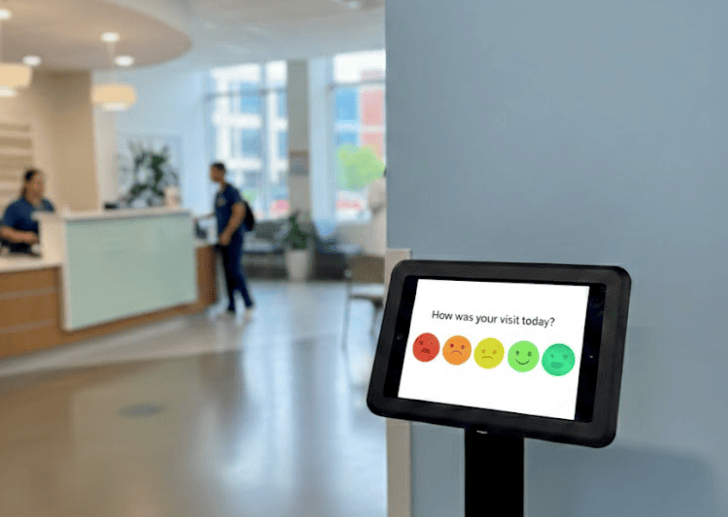
Many institutions use alternate technology to obtain real-time feedback, mostly in the form of surveys on feedback kiosks placed in waiting rooms or on hand held tablets. The mechanism is simple but powerful:
Patient Journey with Real-Time Kiosks:
- Patient completes service touchpoint (check-in, discharge, waiting room experience)
- Kiosk prompt appears immediately (same day, ideally within minutes)
- Patient provides feedback via simple interface (smiley buttons, 1-5 scale)
- Data transmits instantly to operations dashboard
- Leadership responds within hours, not weeks
3.2 Proven Response Rate Improvements
Real-time feedback is collected immediately. Real-time feedback offers higher response rates as feedback is gathered instantly.
Healthcare organizations deploying kiosk-based feedback see response rates of 40-60% vs. the 24% average for traditional HCAHPS surveys, this is a 70-150% improvement in data capture.
3.3 Immediate Service Recovery Capability
Real-time feedback allows for immediate service recovery, enabling institutions to rounding on families who provided negative feedback within a few hours of receiving the feedback, and following up until the issue can be entirely resolved.
When leadership implements this discipline:
- A patient rates cleanliness as poor at 2 PM
- Operations team is notified by 2:30 PM
- Environmental services increases attention to affected area by 3 PM
- Leadership follows up with patient by 4 PM
- Patient perception shifts from “the hospital doesn’t care” to “they fixed it immediately”
IV. Impact on HCAHPS Scores: The Data
4.1 Environmental Cleanliness (HCAHPS Key Domain)
HCAHPS specifically measures whether patients believe the room and bathroom were clean. This domain is highly responsive to real-time feedback intervention because:
- Issues like cleanliness are immediately observable
- Real-time kiosks capture the moment a patient notices a problem
- Operations teams can address issues while patients are still in-facility
- Recovery conversations can happen same-day
Healthcare systems implementing real-time feedback on environmental metrics report:
- 3-7 point improvements in HCAHPS cleanliness scores within 6-12 months
- Higher consistency across departments
- Better staff accountability when real-time data shows specific areas needing attention
4.2 Staff Responsiveness (HCAHPS Critical Domain)
When staff members know feedback is being captured in real-time, behavior shifts. Response rates to these surveys are higher when staff remind patients to complete surveys or when surveys are verbally facilitated. This creates beneficial accountability:
- Staff who know real-time feedback exists become more responsive
- Negative patterns become visible quickly, enabling targeted training
- High-performing units receive recognition, driving cultural improvements
4.3 Integrated Impact on HCAHPS Global Rating
The HCAHPS “overall rating” question “Would you recommend this hospital?” synthesizes patient perception across all touchpoints. By implementing real-time feedback and demonstrating responsiveness across multiple domains, hospitals improve this critical metric.
V. Implementation Strategy for Hospital Service Desks
5.1 Optimal Kiosk Placement for Service Desk Operations
Service desks are ground-zero for patient and family experience in hospitals. Real-time feedback kiosks should be placed at:
- Main Service Desk Area: Near patient check-in, where staff interactions are visible and fresh
- Captures wait time, staff responsiveness, communication clarity
- High traffic = higher response rates
- Service Desk Exit Point: As patients leave the desk area
- Immediate feedback on desk-specific interaction
- Patient can rate specific staff member behavior if needed
- Discharge Service Desk (if separate): As patients complete discharge process
- Highest-value moment for HCAHPS relevant feedback
- Captures discharge communication, clarity of instructions and staff courtesy
5.2 Question Strategy for Service Desk Contexts
Rather than administering full HCAHPS surveys via kiosk (which would discourage completion), implement targeted micro-surveys:
Immediate Touchpoint Question:
- “How would you rate the helpfulness of our service desk staff?” (1-5 scale)
- Single question takes 5 seconds to answer
- Dramatically higher completion rate than multi-question surveys
Optional Drill-Down (only if rating is negative):
- “What could we have done better?” (open-ended)
- Captures actionable detail without survey fatigue
Timing: Surveys delivered immediately after desk interaction, before patient leaves desk area
5.3 Technology Integration with Hospital Systems
Modern real-time feedback kiosks integrate with hospital operations systems:
- EHR Integration: Link feedback to patient encounter data
- Department Routing: Automatically route cleanliness issues to environmental services, responsiveness issues to department manager
- Dashboard Visibility: Real-time operational dashboard showing current-day feedback by department
- Alert System: Immediate notification to manager when negative feedback received, enabling same-day response
VI. Expected ROI and Timeline
6.1 Financial Returns
Based on hospital case studies and the data presented above:
Year 1 Investment:
- Kiosk hardware and software: $2,000-$7,500 depending on deployment scale
- Implementation and training: $1,500-$2,500
- Total Year 1: $3,500 – $10,000
Year 1-2 Returns:
- If 4-point HCAHPS improvement achieved (conservative estimate for focused effort)
- For a 300-bed hospital: a modest 1-point improvement × $37.5M in HCAHPS-tied revenue = $150,000-$300,000 additional annual revenue depending on performance comparison percentile
- ROI: More than 40x first year
6.2 Timeline to HCAHPS Score Improvement
HCAHPS scores are reported on a quarterly basis with a lag (Q1 data reported in Q3). However:
- Weeks 1-4: Data collection begins, operational patterns emerge
- Weeks 4-8: First service recovery conversations change patient narratives
- Months 2-3: Staff behavior shifts as accountability becomes visible
- Months 3-6: HCAHPS survey respondents reflect improved experiences from this period
- Months 6-9: First HCAHPS data with full feedback cycle shows improvement
- Months 9-12: Full year of data demonstrates sustained improvement trajectory
Conservative timeline to see HCAHPS improvement: 6-9 months Typical improvement timeline: 3-6 months for operational metrics, 6-12 months for HCAHPS score reflection
VII. Best Practices for Success
7.1 Leadership Commitment
Hospitals that see dramatic HCAHPS improvements from real-time feedback share one characteristic: leadership personally responds to negative feedback.
Units with leadership that invested significant time into responding to negative responses, rounding on families who provided negative feedback within a few hours, and following up until the issue could be entirely resolved showed improved scores. On units that showed decreased scores, leadership either did not receive negative responses or did not have a process in place to respond. G2
Critical Success Factor: Assign a senior leader to review real-time feedback daily and personally respond to negative feedback within 4 hours when possible.
7.2 Staff Communication and Culture
Staff must understand that real-time feedback is for improvement, not punishment. Frame it as:
- “We’re giving patients a voice so we can serve them better”
- “Real-time feedback helps us catch and fix issues before they reach official surveys”
- “High performers will be recognized through feedback data”
7.3 Closing the Loop with Patients
When a patient provides negative feedback via kiosk, follow-up should happen same-day:
Service Recovery Script:
- “We saw your feedback about [specific issue] today at [time]”
- “That’s not the experience we want you to have”
- “Here’s what we’ve done about it: [specific action]”
- “We’d appreciate the chance to earn back your trust”
This transforms a negative experience into a recovery story, often resulting in higher satisfaction than patients who had no problems initially.
VIII. Competitive Advantage: Why Now?
The hospitals currently leading HCAHPS rankings have already implemented real-time feedback systems. Some of the highest-rated hospitals in the world, those consistently topping national rankings, use real-time feedback tools to continuously monitor and improve patient experience while care is still being delivered.
For hospitals not yet implementing real-time feedback, the competitive gap widens monthly as leaders improve their HCAHPS scores while traditional-approach hospitals plateau.
IX. Conclusion
The data is clear: post-discharge surveys are no longer sufficient for hospitals seeking to optimize HCAHPS scores and the revenue tied to them. Real-time feedback is best for addressing immediate patient concerns and making rapid adjustments in fast-paced environments, and both SurveyStance real-time feedback and patient surveys are complementary rather than substitutive.
For hospital service desks specifically, real-time feedback kiosks are:
- Cost-effective: Very affordable and easy to scale
- Quick to implement: 6-9 months to see HCAHPS improvement
- High impact: 3-7 point improvements in targeted HCAHPS domains are achievable
- Competitive necessity: Leaders are already using this approach
The question is not whether to implement real-time feedback kiosks, but how quickly your hospital can deploy them to close the gap with top performers.